Sponsored
Sponsored
Free Edition
Verified Content
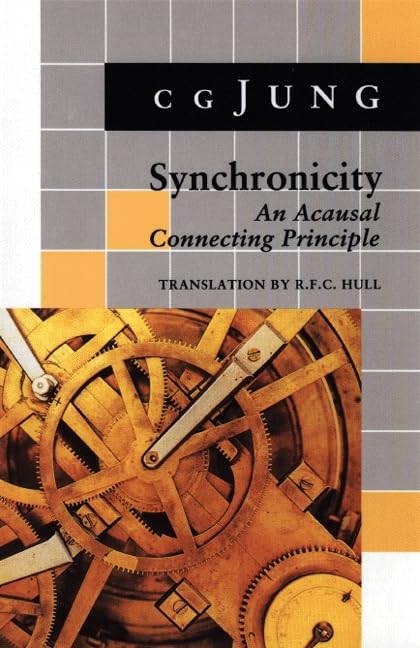
Synchronicity: An Acausal Connecting Principle
Overview
Jung's only extended work in the field of parapsychology aims, on the one hand, to incorporate the findings of "extrasensory perception" (ESP) research into a general scientific point of view and, on the other, to ascertain the nature of the psychic factor in such phenomena. While he had advanced the "synchronicity" hypothesis as early as the 1920s, Jung gave a full statement only in 1951, in an Eranos lecture; the following year (he was seventy-seven) he published the present monograph in a volume with a related study by the physicist (and Nobel winner) Wolfgang Pauli. Together with a wealth of historical and contemporary material on "synchronicity," Jung describes an astrological experiment conducted to test his theory."The concept of synchronicity indicates a meaningful coincidence of two or more events, where something other than the probability of chance is involved. Chance is a statistical concept which 'explains' deviations within certain patterns of probability. Synchronicity elucidates meaningful arrangements and coincidence which somehow go beyond the calculations of probability. Pre-cognition, clairvoyance, telepathy, etc. are phenomena which are inexplicable through chance, but become empirically intelligible through the employment of the principle of synchronicity, which suggests a kind of harmony at work in the interrelation of both psychic and physical events."
—The Journal of Religious Thought
—The Journal of Religious Thought


36,114 currently reading


152,889 want to read
Sponsored
Sponsored
Book details & editions
| ISBN | 0691017948 |
| Publisher | Princeton University Press |
| Publication date | January 1952 |
| Language | English |
| Pages | 115 pages |
Sponsored
Sponsored




Ratings & Reviews
5 ★
42%
4 ★
34%
3 ★
16%
2 ★
5%
1 ★
3%
3.99
BlueReads Choice
Sponsored
Write a Review
Community Reviews
Sort by: