Sponsored
Sponsored
Free Edition
Verified Content
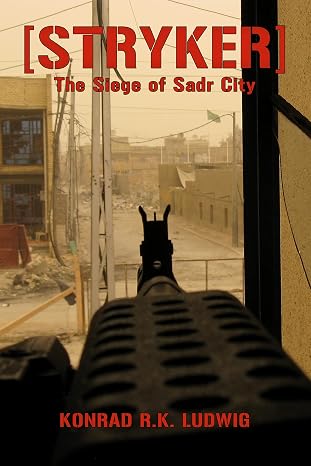
Stryker: The Siege of Sadr City
Overview
Twenty years ago, the 2008 Battle of Sadr City changed the course of the Iraq War. Almost nobody knows it happened.
For nearly three months, American infantrymen fought block-by-block through the most densely populated district of Baghdad — a district with over 2.5 million residents. Their enemy was a radical fundamentalist militia known as the Jaish al-Mahdi, which had been trained and supplied by Qasem Soleimani’s Quds Force and Hezbollah's Unit 3800.
For years, the Jaish al-Mahdi had dug into Sadr City, amassed an arsenal of sophisticated weaponry and tactics, and prepared for all-out conflagration against the United States. Bolstered by elite “special groups” of snipers and anti-armor strike teams, they maintained a twenty-minute response time anywhere in the city, fighting toe-to-toe with American special operations groups and conventional infantry who dared enter their stronghold. After five years of combat, they had earned their place as the most strategically capable adversary in Iraq.
According to RAND, the 2008 Battle of Sadr City established a new paradigm for urban combat. West Point's Modern War Institute selected the battle as a case study in its Urban Warfare Project to train the next generation of American combat officers. The men who fought in the streets received a Valorous Unit Citation for their accomplishments.
Almost none of this made the news.
Stryker: The Siege of Sadr City is one of the few ground-level accounts of the 2008 Battle of Sadr City. Sergeant Ludwig's gripping narrative offers an unfiltered view through the sights of his machine gun. He documents the twenty-minute countdown that governed entrance into the city, the psychological effect of maintaining a 36-hour patrol cycle for eight months, and every brutal turn in what would become one of the largest and bloodiest battles of Operation Iraqi Freedom.
This fourth revised version has been cited by the RAND Corporation in its official study of the battle. It has been endorsed by Lieutenant Colonel Mark J. Reardon (Senior Military Historian at the U.S. Army Center of Military History) and Colonel David E. Johnson, Ph.D. (Ret.) (Senior Political Scientist at the RAND Corporation). It has been used as primary source material in undergraduate and postgraduate courses on military history, foreign policy, and contemporary literature.
For nearly three months, American infantrymen fought block-by-block through the most densely populated district of Baghdad — a district with over 2.5 million residents. Their enemy was a radical fundamentalist militia known as the Jaish al-Mahdi, which had been trained and supplied by Qasem Soleimani’s Quds Force and Hezbollah's Unit 3800.
For years, the Jaish al-Mahdi had dug into Sadr City, amassed an arsenal of sophisticated weaponry and tactics, and prepared for all-out conflagration against the United States. Bolstered by elite “special groups” of snipers and anti-armor strike teams, they maintained a twenty-minute response time anywhere in the city, fighting toe-to-toe with American special operations groups and conventional infantry who dared enter their stronghold. After five years of combat, they had earned their place as the most strategically capable adversary in Iraq.
According to RAND, the 2008 Battle of Sadr City established a new paradigm for urban combat. West Point's Modern War Institute selected the battle as a case study in its Urban Warfare Project to train the next generation of American combat officers. The men who fought in the streets received a Valorous Unit Citation for their accomplishments.
Almost none of this made the news.
Stryker: The Siege of Sadr City is one of the few ground-level accounts of the 2008 Battle of Sadr City. Sergeant Ludwig's gripping narrative offers an unfiltered view through the sights of his machine gun. He documents the twenty-minute countdown that governed entrance into the city, the psychological effect of maintaining a 36-hour patrol cycle for eight months, and every brutal turn in what would become one of the largest and bloodiest battles of Operation Iraqi Freedom.
This fourth revised version has been cited by the RAND Corporation in its official study of the battle. It has been endorsed by Lieutenant Colonel Mark J. Reardon (Senior Military Historian at the U.S. Army Center of Military History) and Colonel David E. Johnson, Ph.D. (Ret.) (Senior Political Scientist at the RAND Corporation). It has been used as primary source material in undergraduate and postgraduate courses on military history, foreign policy, and contemporary literature.


36,114 currently reading


152,889 want to read
Sponsored
Sponsored
Book details & editions
| ISBN | 0985339810 |
| Publisher | Roland-Kjos Publishing |
| Publication date | April 2013 |
| Language | English |
| Pages | 446 pages |
Sponsored
Sponsored




Ratings & Reviews
5 ★
58%
4 ★
28%
3 ★
10%
2 ★
3%
1 ★
1%
4.37
BlueReads Choice
Sponsored
Write a Review
Community Reviews
Sort by: