Sponsored
Sponsored
Free Edition
Verified Content
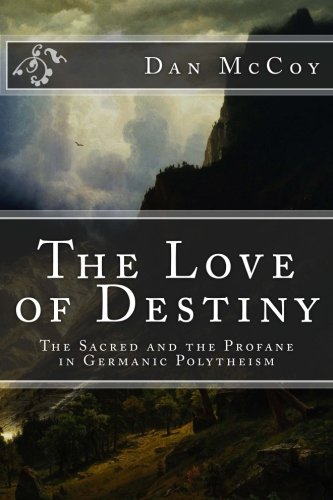
The Love of Destiny: The Sacred and the Profane in Germanic Polytheism
Overview
The Love of Destiny: The Sacred and the Profane in Germanic Polytheism is a relatively short book by Dan McCoy, the author of the articles on Norse-Mythology.org. Written in a style that is somewhere between a philosophy essay and a prose poem, The Love of Destiny is a much fuller presentation of many of the recurring big-picture themes in the articles on this site. It attempts to articulate the heart of the indigenous Germanic worldview – the unconditional affirmation of the world as the very embodiment of the gods – and to show how the rest of that worldview is structured around that central idea. To do this, it “translates” the narratives and images that comprise the pre-Christian mythology of the Norse and other Germanic peoples into the more familiar idiom of conceptual language, and contrasts this polytheistic mythology with the mythology of four monotheistic religions: ancient Judaism, Greek rationalism, Christianity, and modern science. It argues that many of the most pressing philosophical and theological debates of the last several centuries, such as those over the “problem of evil” and the relationship between the “objective” and the “subjective,” frame the issues in counterproductive, “otherworldly” ways, and shows how Germanic polytheism offers compelling alternatives. Ultimately, it evokes a way of engaging with the more-than-human world that honors our inescapable entanglement within it.
See below for the Table of Contents and a sample section.
When you purchase a copy of this book, you help keep this site up and running, and I sincerely hope you feel that you’ve gotten your money’s worth and then some. This book was the result of several years of research, experience, contemplation, and writing. I wrote and scrapped three different versions of it before finally arriving at a version that I felt satisfied with enough to offer publicly. Hopefully that effort is apparent in the quality of the text itself.
Tables of Contents
Introduction
I. Prologue
- Polytheism and Monotheism
II. The Origins and Worldview of Monotheism
- The Hebrews
- The Greeks
- The Christians
- The Scientists
III. The Sacred and the Profane
- Spirit and Flesh
- Myth
- Reason
- Perspectivism
IV. Destiny
- The Turning of Being
- The Eternal Circle
Glossary of Old Norse Words
Bibliography
Sample Section
This is the section “Spirit and Flesh” from Chapter Three, “The Sacred and the Profane:”
From a polytheistic perspective, the visible world is not a negation of the invisible world of spirit, but its fulfillment. The words that William Blake chose to end The Marriage of Heaven and Hell, “Everything that lives is holy,” apply to all that we perceive and experience, no matter how grand and luminous, no matter how vile and distressing.
In his unfinished masterpiece, The Visible and the Invisible, the French phenomenologist Maurice Merleau-Ponty wrote: “[Ideas] could not be given to us as ideas except in a carnal experience. It is not only that we would find in that carnal experience the occasion to think them; it is that they owe their authority, their fascinating, indestructible power, precisely to the fact that they are in transparency behind the sensible, or in its heart… [The idea] is the invisible of this world, that which inhabits this world, sustains it, and renders it visible.” The intuition and imagination, far from being “subjective” and therefore of little to no consequence where the real is concerned, have an openness upon the real that equals that of the senses. The mythical beings, realms, and events that they perceive are not false or nonexistent simply because they elude the senses, but rather dwell within an ordinarily latent – and yet ultimately deeper – modality of the world. Nor should the senses be shunned, for that which they divulge is fastened to that which is divulged by the invisible components of perception. Perception’s visible and invisible parts cannot be isolated from one another; both are integrated into a seamless whole. Such, at least, is how we are surely to understand the Roman historian Tacitus’s description of the religion of the Germanic tribes: “Their holy places are the woods and groves, and they apply the names of gods to those hidden presences seen only by the eye of reverence.”
Despite its origins in the Latin word mater, “mother,” our modern word “matter” has been invested with connotations of inertness, insensitivity, barrenness. To call it “dead” would be to impart to it too much life – it was never living in the first place. Against this Cartesian tendency, Merleau-Ponty described the visible world as flesh, within which all of us visible beings are intertwining sinews.
There is a particular resonance with Germanic mythology in his choice of words. Before the world as we today know it had emerged, there was only the primordial chaos of Ginnungagap (“Great Abyss”). Ymir (“Scream”), the animating spirit of this void of undist...
See below for the Table of Contents and a sample section.
When you purchase a copy of this book, you help keep this site up and running, and I sincerely hope you feel that you’ve gotten your money’s worth and then some. This book was the result of several years of research, experience, contemplation, and writing. I wrote and scrapped three different versions of it before finally arriving at a version that I felt satisfied with enough to offer publicly. Hopefully that effort is apparent in the quality of the text itself.
Tables of Contents
Introduction
I. Prologue
- Polytheism and Monotheism
II. The Origins and Worldview of Monotheism
- The Hebrews
- The Greeks
- The Christians
- The Scientists
III. The Sacred and the Profane
- Spirit and Flesh
- Myth
- Reason
- Perspectivism
IV. Destiny
- The Turning of Being
- The Eternal Circle
Glossary of Old Norse Words
Bibliography
Sample Section
This is the section “Spirit and Flesh” from Chapter Three, “The Sacred and the Profane:”
From a polytheistic perspective, the visible world is not a negation of the invisible world of spirit, but its fulfillment. The words that William Blake chose to end The Marriage of Heaven and Hell, “Everything that lives is holy,” apply to all that we perceive and experience, no matter how grand and luminous, no matter how vile and distressing.
In his unfinished masterpiece, The Visible and the Invisible, the French phenomenologist Maurice Merleau-Ponty wrote: “[Ideas] could not be given to us as ideas except in a carnal experience. It is not only that we would find in that carnal experience the occasion to think them; it is that they owe their authority, their fascinating, indestructible power, precisely to the fact that they are in transparency behind the sensible, or in its heart… [The idea] is the invisible of this world, that which inhabits this world, sustains it, and renders it visible.” The intuition and imagination, far from being “subjective” and therefore of little to no consequence where the real is concerned, have an openness upon the real that equals that of the senses. The mythical beings, realms, and events that they perceive are not false or nonexistent simply because they elude the senses, but rather dwell within an ordinarily latent – and yet ultimately deeper – modality of the world. Nor should the senses be shunned, for that which they divulge is fastened to that which is divulged by the invisible components of perception. Perception’s visible and invisible parts cannot be isolated from one another; both are integrated into a seamless whole. Such, at least, is how we are surely to understand the Roman historian Tacitus’s description of the religion of the Germanic tribes: “Their holy places are the woods and groves, and they apply the names of gods to those hidden presences seen only by the eye of reverence.”
Despite its origins in the Latin word mater, “mother,” our modern word “matter” has been invested with connotations of inertness, insensitivity, barrenness. To call it “dead” would be to impart to it too much life – it was never living in the first place. Against this Cartesian tendency, Merleau-Ponty described the visible world as flesh, within which all of us visible beings are intertwining sinews.
There is a particular resonance with Germanic mythology in his choice of words. Before the world as we today know it had emerged, there was only the primordial chaos of Ginnungagap (“Great Abyss”). Ymir (“Scream”), the animating spirit of this void of undist...


36,114 currently reading


152,889 want to read
Sponsored
Sponsored
Book details & editions
| ISBN | 1492761559 |
| Publisher | Dan McCoy |
| Publication date | January 2013 |
| Language | English (US) |
| Pages | 97 pages |
Sponsored
Sponsored




Ratings & Reviews
5 ★
42%
4 ★
34%
3 ★
16%
2 ★
5%
1 ★
3%
3.60
BlueReads Choice
Sponsored
Write a Review
Community Reviews
Sort by: