Sponsored
Sponsored
Free Edition
Verified Content
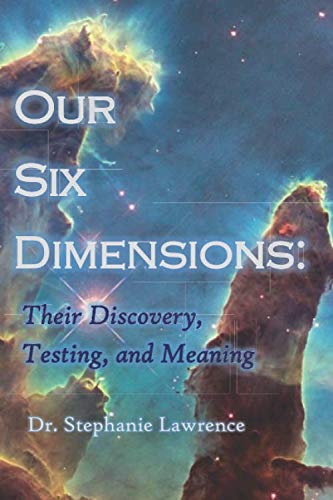
Our Six Dimensions: Their Discovery, Testing, and Meaning
Overview
Our Six Dimensions by Dr. Stephanie Lawrence Dr. Lawrence observed an early form of Our Six Dimensions and used stratified proportionate sampling to test and compares her results against traditionally known three dimensions. Ends up traditionally known three dimensions are a method of measurement and we live in six dimensions. Lawrence uses 347 cases (rounding error decreased 350 cases to 347) to generalize findings to the population. While four cases support three dimensions, all cases support her dimensions. The process of dimensions changing their formatting via hyper-cube is explained. When formatted in linear sequence to test against traditionally known Big Bang theory, one candidate sequence using the six dimensions is very strong. Multiple realities plus negative time are examined and supported, plus these six dimensions are the unified fields which provide structure to the Theory of Everything. The mechanism of false dichotomies, where either/ or choice is presented such as Chicken vs Egg are clarified. Format 2x2 table with egg across the top, chicken goes down the side. Now put a plus sign (+) as one column header, put negative sign (-) as other column header. Do the same with chicken with plus and negative signs as row headers. Fill in the four blank squares. The egg square ( +, - ) means the egg came first, chicken square ( -, + ) means the chicken came first. Both chicken and egg square ( +, + ) means spontaneous generation occurred and neither chicken nor egg square ( -, - ) means something else came first such as dinosaurs. A recently deceased British physicist was unable to format a Theory of Everything so that physicist supported Godel's Incompleteness theory (Theory of Everything involved only numbers). Except Lawrence's research indicates words plus numbers are used. Lawrence provides real world examples and also uses the six dimensions plus spikes in her research measurement of businesses as urban cultural icons. Using all six dimensions Lawrence formats a Guttman scale to measure 58 business cases from around the globe. All businesses in the study score rank from Local Cultural, Focal Cultural, Zonal Cultural, to Global Cultural icons with their Globalization Index scores. Statistical tests support her findings on the six dimensions. Through mapping those findings in 10 to 20 year increments urban planners can observe ratio changes of cities. Most cities begin with 100: 0: 0: 0 ratio having all local cultural icon businesses, with the ratio blend subsequently changing through time. A purely global cultural icon ratio for a city would be 0: 0: 0: 100 with all businesses being global cultural icons. Urban planners can use these ratios to revise urban landscapes.


36,114 currently reading


152,889 want to read
Sponsored
Sponsored
Book details & editions
| ISBN | 1733325700 |
| Publisher | |
| Publication date | October 2026 |
| Language | English |
| Pages | 444 pages |
Sponsored
Sponsored



Ratings & Reviews
5 ★
76%
4 ★
18%
3 ★
4%
2 ★
1%
1 ★
1%
5.00
BlueReads Choice
Sponsored
Write a Review
Community Reviews
Sort by: